

OPERATING LEASE
An Opportunity for Growth
Operating rental is an alternative to purchasing and leasing that allows professionals and businesses to access the equipment and services they need through a periodic fee (for a predetermined duration).
It is a practical, innovative commercial solution that eliminates the issues associated with purchasing and final ownership, limiting upfront capital outlay and allowing convenient upgrading of essential equipment.
Operating rental guarantees financial planning security and predictable expenditure with no additional costs.
BENEFITS OF OPERATING LEASING
BONTEMPI Operating Lease
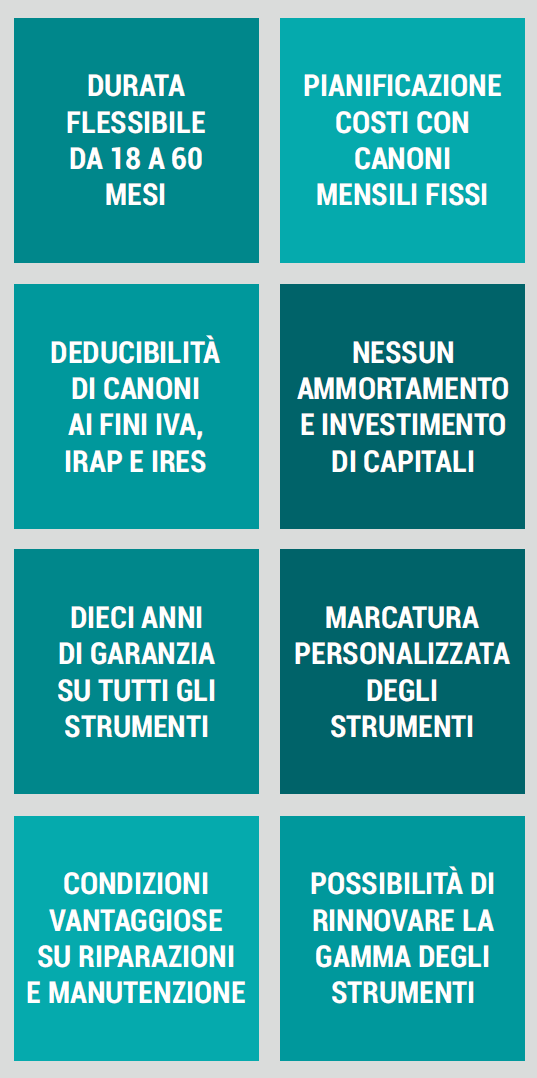
An operating lease for capital equipment provides that the business and professional equipment required is purchased by a party known as the “lessor” and leased to an end customer, known as the “lessee” or user of the asset, for a fixed period stipulated in the contract, in exchange for a periodic fee, i.e., a fixed installment.
This is a particular form of financing closely resembling financial leasing, yet offering more advantageous tax characteristics for the end user.
The end customer pays for the asset in installments in the form of a rental fee. Upon expiration of the agreed term, they have the option to acquire ownership of the asset or extend the operating lease by replacing the equipment.
Operating leases for capital equipment offer numerous tax and deductibility advantages.
First, all issues related to depreciation and fixed asset management are eliminated; moreover, the installments are fully deductible for IRES and IRAP tax purposes (and VAT-deductible), meaning that unlike financial leasing, an operating lease for capital equipment offers 100% deductibility.
The advantage of this type of contract therefore lies in the ability to use capital equipment on a temporary basis without investing in its purchase.
CUSTOMIZATION OF SURGICAL INSTRUMENTS
Included in the Operating Lease service is customization via LASER marking,
or through an Electrolysis process, of all surgical instruments included in the supply.
Upon specific customer request, Bontempi can customize the instruments with the name
of the Practice, Clinic/Facility, Department, and/or the Physician's Name.
50% DISCOUNT ON INSTRUMENT REPAIR AND MAINTENANCE
Bontempi provides a dedicated service for its customers offering repair and reconditioning of all
its instruments and, where required, replacement of Tungsten Carbide inserts.
The repair service includes machining, joint inspection, cleaning, and complete overhaul of the instrument.
Main Steels for Surgical Instruments
AISI 420 STEEL
Martensitic steel with distinctive mechanical properties that make it suitable for a wide range of uses. In the hardened and tempered condition with mirror-polished surfaces, it exhibits good corrosion resistance in moderately aggressive non-chlorinated environments.
AISI 420C STEEL
Martensitic steel, hardenable to a hardness exceeding 52 HRC. Maximum corrosion resistance is achieved in the hardened, stress-relieved, and polished condition. It is not intended for use in welded components.
AISI 440A/B/C STEEL
Martensitic stainless steel with high C and Cr content and correspondingly high hardness after quenching (approx. 57 HRC). In the hardened and tempered condition and after polishing, it exhibits good corrosion resistance in air, fresh water, gasoline, and foodstuffs.
The carbon content of this stainless steel is approximately: A (0.75%), B (0.9%), C (1.2%). 440C is an excellent stainless steel, typically around 56–58 Rc, very hard, and with good edge retention.
Hardening and Tempering
The materials normally used for manufacturing surgical instruments are hardenable high-carbon chromium steels, “AISI (American Iron and Steel Institute) 440 and AISI 420”—that is, martensitic stainless steels containing at least 12% chromium—whose full potential can be developed through an appropriate manufacturing and heat-treatment cycle. Martensitic steels are alloys of iron, carbon, and chromium, to which other elements such as vanadium, molybdenum, nickel, and tungsten are very often added to improve and enhance corrosion resistance, hardness, and toughness. Optimal distribution, bonding, and melting of these elements together makes it possible to produce steel of superior quality.
Hardening (Quenching)
To make the best use of the potential of martensitic stainless steel, heat treatment or hardening is employed. Steel alloyed with other elements develops specific properties depending on the characteristics to be enhanced for its intended use.
In general, what transforms an alloy steel into an optimal cutlery steel is heat treatment (Hardening and Tempering). Every alloy steel is characterized by a critical temperature at which the crystal structure of the steel changes, increasing the solubility of carbon in the ferritic matrix: this temperature must be maintained to achieve austenitizing of the steel, yet not for so long as to promote grain growth.
The next step is rapid cooling (quenching) using various media (water, oil, salt emulsions, ice, air, etc.) to achieve the desired level of hardness.
Tempering
After hardening, the steel is very hard but also very brittle: to achieve a good balance between hardness (which translates into longer edge retention) and reduced brittleness (which translates into greater impact resistance), a second heat treatment (tempering) is always performed to stress-relieve the material subjected to the internal stress induced by hardening and to remove residual stresses.
Materials used during manufacturing
Various types of abrasives, vibratory finishing compounds, etc. are also used during production.
Any residues of these substances are thoroughly removed prior to final packaging through standard and ultrasonic cleaning.
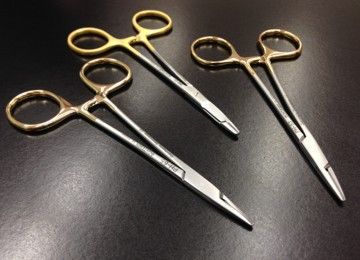
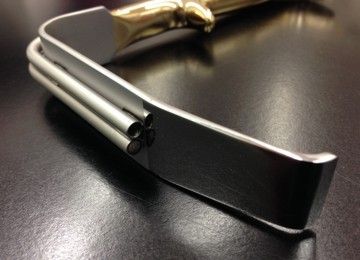
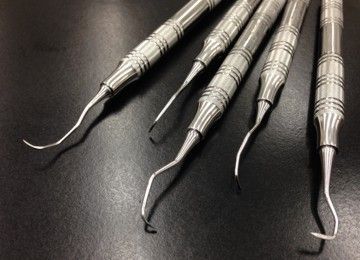
Instrument Composition
CARBON - C
Present in all steels, it is the element that transforms iron into steel, defining the instrument’s elasticity while increasing hardness and cutting-edge durability. On average, steel must contain >0.5% carbon to be classified as “high-carbon steel”.
CHROMIUM - Cr
An element that increases resistance to wear, fatigue, and corrosion. Steel containing at least 13–14% chromium is generally considered “stainless” steel, although this definition is not entirely accurate because, despite its name, all steel can oxidize if no maintenance is carried out.
COBALT - Co
Increases strength and hardness, provides resistance to high temperatures, and enhances the effects of other alloying elements.
MANGANESE - Mn
An important element, as manganese helps the structure increase its hardenability and improves the steel, while deoxidizing and degassing metals during heat treatments.
MOLYBDENUM - Mo
Prevents embrittlement (Krupp’s disease / temper embrittlement) and, by increasing toughness and fatigue resistance, enhances machinability and corrosion resistance.
NICKEL - Ni
Increases hardness and strength. Nickel can also contribute to corrosion resistance, though it is certainly not as effective as chromium and would need to be used in high percentages at the expense of edge retention.
PHOSPHORUS - P
Reduces brittleness; in high concentrations it increases strength and machinability, resulting in greater strength and higher hardness.
ALUMINUM - Al
Used only for handles due to its good machinability and light weight. The material does not come into contact with the patient. There are no issues with sterilization.
TEFLON - (C2F4)n
Material with high biocompatibility. Used for internal components of forceps. Sterilization does not cause degradation of its properties.
TITANIUM - Ti
New titanium alloys deliver high performance: they are extremely resistant to oxidation, lightweight, abrasion-resistant, and non-magnetic. Due to the particular difficulty of machining them, they carry a higher cost.
TITANIUM NITRIDE - TiN
Material used as a non-stick coating on certain instruments employed for modeling pastes and composites.
TUNGSTEN CARBIDE - WC
It is used to increase the wear resistance of specific surfaces, such as on needle holders, forceps, and scissor blades, to extend cutting edge durability.
CERAMIC
Ceramic instruments, particularly scissors, feature extremely hard blades made from zirconia enriched with magnesium, silicon, and calcium. Ceramic offers unique characteristics such as above-average edge retention and maximum hygiene thanks to its inert material composition, which does not react with the tissues it contacts and is easy to clean.
PAINTS
Polyurethane-based paints are used to color-code parts of the handles of certain instruments for identification purposes. Once cured, the coating is stable and is unaffected by the agents normally present in the instrument’s operating environment. The patient never comes into contact with the paint, as it is not applied to the working surfaces but only to part of the handle. Healthcare professionals who properly wear latex gloves neither absorb any pigment nor compromise the paint layer. Therefore, the color coating has no effect on either the patient or the operator.
GOLD and GLASS
The former is used on specific products with particular aesthetic requirements, exclusively on the handles. In any case, the element is exceptionally well tolerated by the human body. The latter is used in the manufacture of mirrors. There are no issues with tissue compatibility or sterilization.
RHODIUM - Rh
Used to externally coat the reflective surface of mirrors. The material is resistant to acids and is inert.