

IN THE DOCTOR'S WORDS
Brow Lift
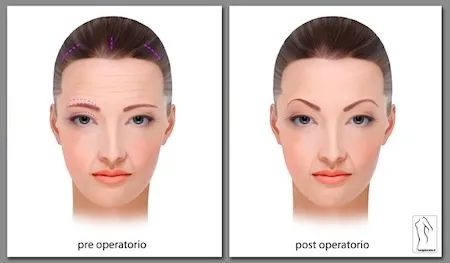
Signs of facial aesthetic imperfections such as eyebrow ptosis combined with a high forehead may occur both in younger individuals, as a hereditary familial trait, and in adults as a sign of aging—namely eyebrow ptosis caused by forehead dermatochalasis.
The differing pathogenesis calls for different treatment approaches, ranging from minimally invasive para-surgical procedures to full surgical interventions.
The goal of an eyebrow lift (browlifting) is to make the upper third of the face more harmonious within the context of the entire face. We believe that any enhancement made to this region must necessarily respect both the morphology and the functionality of the anatomical structure itself.
by Prof. Luca Piovano
Procedure
Many techniques have been described in the past and still retain specific validity today. Our current approach to the brow lift starts with assessments made during the physical examination: facial dynamics and gravitational descent, definition of the relationships with the underlying osteomuscular framework, hypoplasia, and the eyebrow-to-hairline distance are among the most important factors in properly guiding our treatment.
Our strategy essentially relies on tailoring the technique to each individual case:
Direct endoscopic lift
Direct transcutaneous lift
Castañares lift
Indirect transpalpebral lift
The brow lift is indicated to reduce the aesthetic imperfection of an excessive eyebrow-to-hairline distance, improving the relative ptosis of the brow body and tail and consequently restoring proper proportions to the harmony of the entire face.
Every surgical procedure results in a scar. Wound healing is a biologically complex phenomenon that unfolds through several phases. Maturation is the final phase and extends over many months, sometimes even years.
It is therefore clear that the patient must wait the necessary time for scar stabilization before being able to observe its final appearance. The surgeon will employ all appropriate techniques to achieve a quality scar that is fine and flush with the surrounding skin.
However, certain factors can alter the normal healing process; these include vascular and innervation abnormalities, protein deficiency, the use of antineoplastic drugs, diabetic microangiopathy, and cigarette smoking.
Furthermore, pathological forms of scarring can occur based on individual predisposition, potentially leading to the formation of a hypertrophic scar or, in more severe cases, a keloid scar. Should an unsightly scar develop, improvements can always be achieved through medical or surgical therapy.
It should also be kept in mind that any surgical procedure—however minor and limited it may be, and even when performed on patients in good general health—always carries the unpredictable possibility of general complications, the type and severity of which are also unpredictable.
Statistically, for individuals in good general health whose clinical tests show no abnormalities that could increase the risk profile, the likelihood of severe or very severe complications is virtually theoretical. Finally, photographs are important in plastic surgery as an indispensable diagnostic tool.
They will be taken before and after surgery and attached to the patient’s confidential medical record as clinical documentation. Preoperative photographs may be used by the surgeon to discuss the procedure with patients. They may also be used for scientific purposes with an absolute guarantee of anonymity.
The need for a “touch-up” procedure after six months may occasionally arise. This represents a normal stage of refining the outcome rather than an improper execution of the surgery. Its cause lies in the unpredictable settling of the operated tissues, as healing depends not only on the surgeon, but also on the patient’s individual response, ethnicity, and age.
Possible complications
Potential complications are of two types: those related to anesthesia and those related to the surgical procedure itself. As with any surgical intervention, in the immediate postoperative period there is a risk of hematoma or infection, both of which are rare in this type of surgery.
Alterations in cutaneous sensitivity and in the mobility of the facial expression muscles of the upper third of the face may occur. As late complications, slight lateral asymmetries or occasional overcorrections may be observed, which can be addressed with touch-up procedures.
Source: https://lucapiovano.it/